
An automatic satisfaction survey at the end of every conversation
Measuring the quality of human support usually depends on asking by hand or paying for a separate tool just for that. In SDRBOT.ai the satisfaction survey (CSAT) fires on its own when a conversation is completed, straight over WhatsApp, and the result goes right into the metrics of the agent responsible — no manual spreadsheet, and no depending on the lead remembering to answer through a separate link.
Build my SDR free →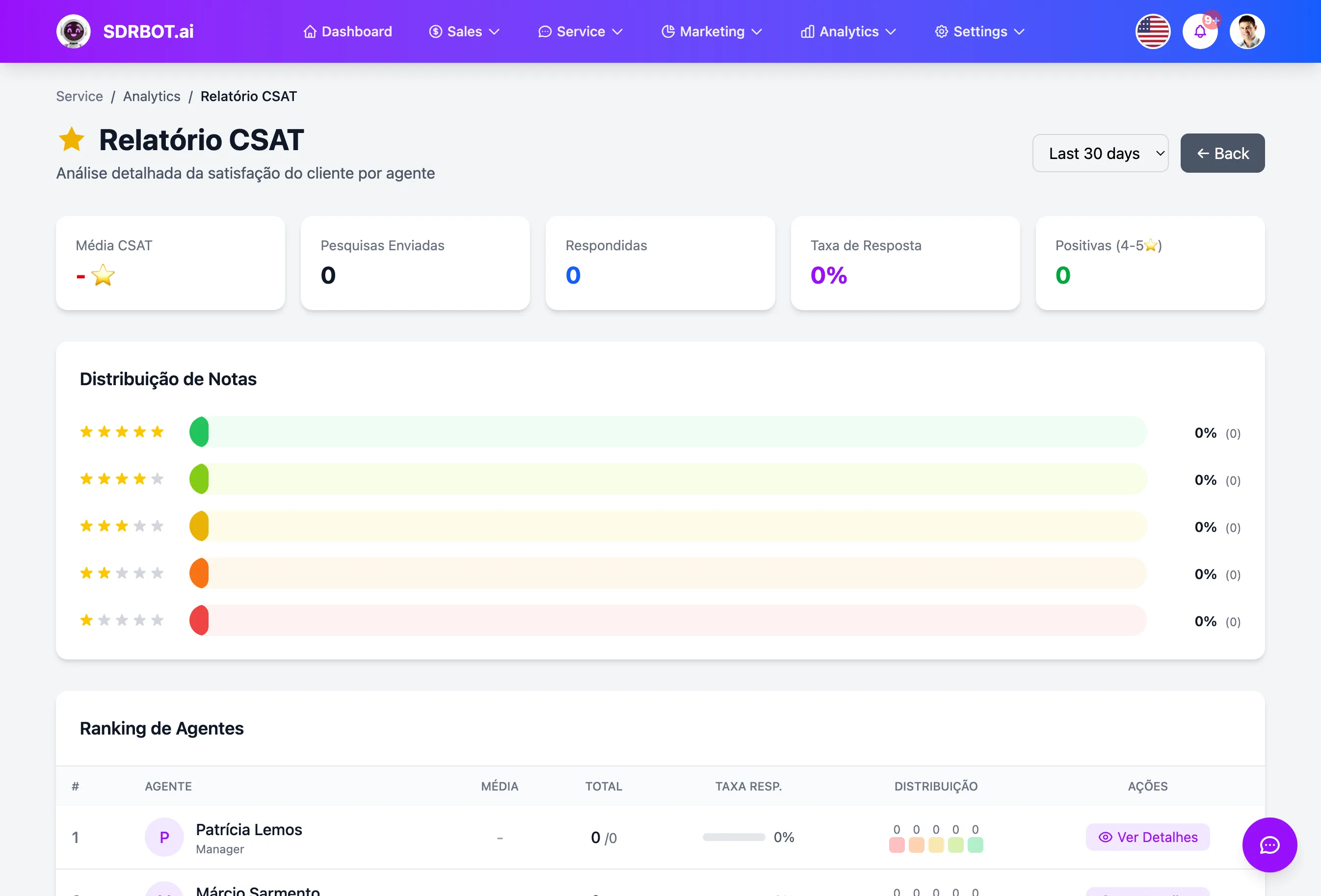
It fires on its own, without sounding robotic
When the agent marks a conversation as completed or as won, the platform waits five minutes before sending the survey — enough not to read as an automated message fired the instant the conversation closed. The lead then receives, on WhatsApp, a satisfaction question rated from 1 to 5 stars, today the channel through which the survey actually reaches them.
There is no external survey tool to configure — the send is part of the conversation closing flow inside the platform itself. That small delay also gives the agent room to record any final note in the conversation before the lead receives the survey, keeping the natural sequence of the support intact.
A flexible answer, with no button required
The lead can answer by tapping an option in the list, typing a number from 1 to 5, sending stars (from ⭐ to ⭐⭐⭐⭐⭐) or writing it out — in English, Portuguese, Spanish, French or Italian, with words like "great", "good", "bad" or "terrible" — and the platform recognizes the answer in any of those formats. That matters because the lead's app does not always render the interactive list perfectly, and not everyone taps exactly where expected.
That answer is only recognized as a CSAT score if it arrives within 24 hours of the survey being sent; past that window, a new message from the same lead goes back to being treated as an ordinary conversation, not a survey answer. Low scores (1 or 2) automatically trigger a request for a comment, to understand what was missing beyond the number.
That tolerance for format lowers the share of surveys that go unanswered, which is the main risk in any CSAT process — if answering is complicated, most leads simply ignore it. Whoever ignores the survey weighs neither for nor against the agent's average: only scores actually given enter the calculation.
A metric per agent, not just an overall one
Each rating is tied to the agent responsible for the handoff that produced that conversation, not only to the organization as a whole. The result appears in the conversation list with a CSAT column, in a dedicated per-agent report — with average score, total ratings received and response rate — and in an overall CSAT card on the main dashboard, with the comments from low scores highlighted for action.
That gives the manager an objective way to identify who is delivering consistently well-rated support and who might need help. Breaking it down per person also makes it possible to compare each agent's progress over time, rather than an overall average that hides whoever is pulling the number down.
Part of closing, not an extra step
Because the survey is born out of the act of marking a handoff as completed, the agent does not have to remember to send anything manually or fill out a separate form — closing the conversation is the trigger. That lowers the chance of the survey simply never happening through forgetfulness, a common problem when collecting satisfaction depends on an extra manual step after the conversation with the lead is already resolved and everyone has moved on to the next one.
For the manager, that means the CSAT indicator grows organically alongside the volume of completed conversations, without requiring a separate feedback collection campaign running on the side.
What changes for your team
- AutomaticIt fires on its own when the conversation closes, with no manual process.
- Easy to answerThe lead replies by number, star or text, on the channel they already used.
- Per agentAverage, volume and negative comments visible person by person.
- Nothing forgottenThe survey comes out of closing the conversation, not an extra step.
Frequently asked questions
Which channel does the satisfaction survey work on?
Today the survey actually goes out over WhatsApp — by far the most used channel in handoff conversations on the platform. Each rating stores the conversation channel of origin along with the score, so the report stays correct even when the conversation itself happened on another channel before the handoff.
What happens if the lead gives a low score?
Scores of 1 or 2 automatically trigger a request for an additional comment, so you can understand the reason for the dissatisfaction beyond the number — the comment is recorded alongside the score and shows up in reports as a case to look at closely, without having to chase the lead down in a separate conversation later.
Can I see the satisfaction of one specific agent?
Yes, there is a per-agent report with average score, total ratings received, response rate and the distribution of scores from 1 to 5 stars, plus an overall CSAT card on the main dashboard of the organization with the top agents for the period.
Works together with
Built for: Gyms Education Healthcare