Automatic follow-up for the lead who stopped replying
Every pipeline has leads who simply vanish mid-conversation — they never said no, they just stopped replying. Chasing those leads by hand means remembering each one, writing again and picking the right moment, one at a time. SDRBOT.ai identifies who actually went silent after the AI SDR's last message, fits that lead into a re-engagement cadence configured by your organization and sends the messages on its own, respecting business hours and the WhatsApp template rules.
Build my SDR free →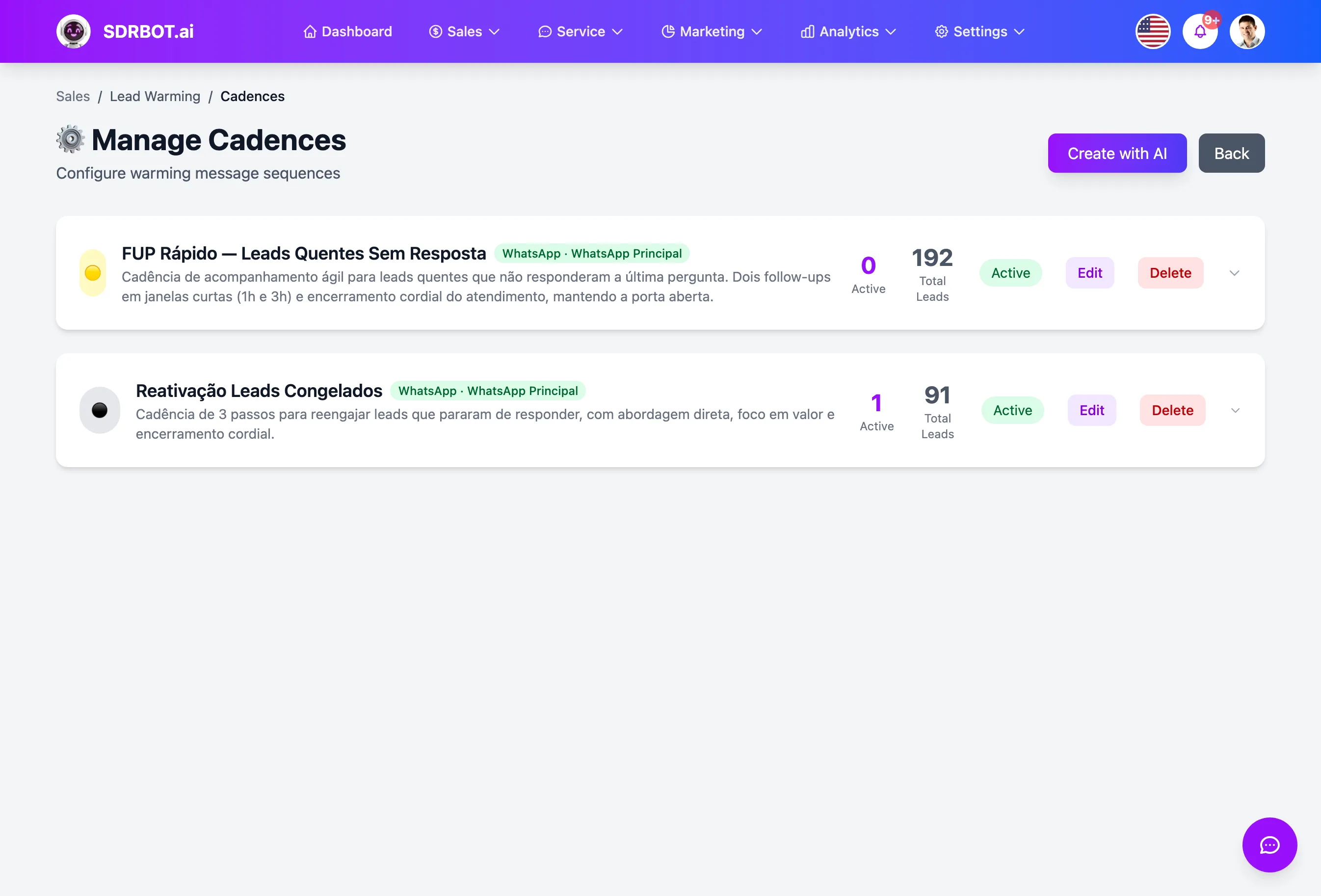
Only the genuinely silent enter the cadence
Before anything else, SDRBOT.ai recalculates the lead's temperature and score — these are not stale numbers from days ago. A lead only counts as a candidate for re-engagement when the last message in the conversation came from the AI SDR and the lead did not reply after it; whoever replied last is still treated as an active conversation, outside the scope of automatic follow-up.
From there, the time of inactivity — in hours or days — and the lead's score decide which cadence applies: each organization configures its own cadences, with a minimum and maximum inactivity range, a minimum lead score and a priority among them, so a recently cooled lead can get a different cadence from one who vanished weeks ago.
Messages only by approved template, at the right hour
Outside the WhatsApp 24-hour window, the only way to send a message is through a template approved by Meta — and that is exactly what the follow-up cadence uses at each step. If the template for a specific step has not been approved yet, the system skips that step and notifies the organization, instead of jamming the whole cadence or trying to send something outside the rules.
Before any send, the platform checks whether it is inside the business hours your organization configured (or the default of 8 AM to 6 PM on weekdays, if you configured nothing). Outside those hours the message is not discarded — it is rescheduled for the next available business hour, so the lead does not get a nudge in the middle of the night.
It stops on its own at the first sign of a reply
As soon as the lead answers any message after entering the cadence, SDRBOT.ai identifies that reply, records its sentiment and marks the cadence as converted — not one more follow-up message goes out after that. The lead goes back to being treated as an ordinary active conversation, no longer bound to an automated script that has already done its job.
Each step of the cadence can also carry conditions of its own: skip automatically if the lead has no email on file, if they have not yet shown interest in any product, or if the last message in the conversation was classified with negative sentiment — in that last case, the following step does not push at a bad moment, and the flow advances without sending that particular message.
A cap on attempts, so it never reads as nagging
Each combination of lead and cadence has a hard limit of two complete cycles over time, and that lock has no exception: both the automatic job and a manual attempt to enroll that lead in the same cadence from the leads screen go through the same check, and the enrollment is refused as soon as the limit is reached, with no way around it in the interface.
A lead who already converted in a specific cadence also cannot be re-enrolled in it, through either path. After a cadence ends or is canceled for a lead, there is still a 60-day gap before they can be considered again for that same cadence — which avoids the feeling of repeated chasing aimed at someone who has already shown, one way or another, that this particular contact was not going anywhere for now.
What changes for your team
- Only those who went silentThe cadence takes the lead the AI SDR already tried who never replied.
- Inside Meta rulesMessages only go out by approved template, never outside policy.
- Stops at the first replyOne reply from the lead ends the cadence right then.
- Never turns into spamA cap of 2 cycles per lead, with a 60-day gap between them.
Frequently asked questions
Does every lead who stops replying automatically enter the follow-up?
Only those who fit a cadence your organization configured — inside the inactivity range and the minimum score defined — who have a valid phone number and have not asked to stop receiving messages. Anyone already in an active conversation, or who replied last, does not enter.
Can a follow-up message arrive in the middle of the night or on a weekend?
No. Before each send the system checks the business hours the organization configured; outside them, the message is rescheduled automatically for the next available business hour, instead of going out at the wrong time. Those hours follow whatever the organization itself configured, or the default of 8 AM to 6 PM on weekdays when there is no specific setting.
What happens if the lead replies in the middle of the cadence?
The cadence stops immediately: the reply is recorded with the sentiment identified, the lead is marked as converted, and not one more follow-up message goes out — the conversation returns to the normal flow, like any other active conversation.
Can a lead be re-engaged as many times as necessary?
No. The cap is two complete cycles per lead in each cadence, with a 60-day pause between them, and that rule holds for the automatic send as well as for a manual attempt to enroll the lead from the leads screen — on hitting the limit, the enrollment is refused either way, with no way around it in the interface.
Works together with
Built for: Solar Energy Real Estate Insurance